
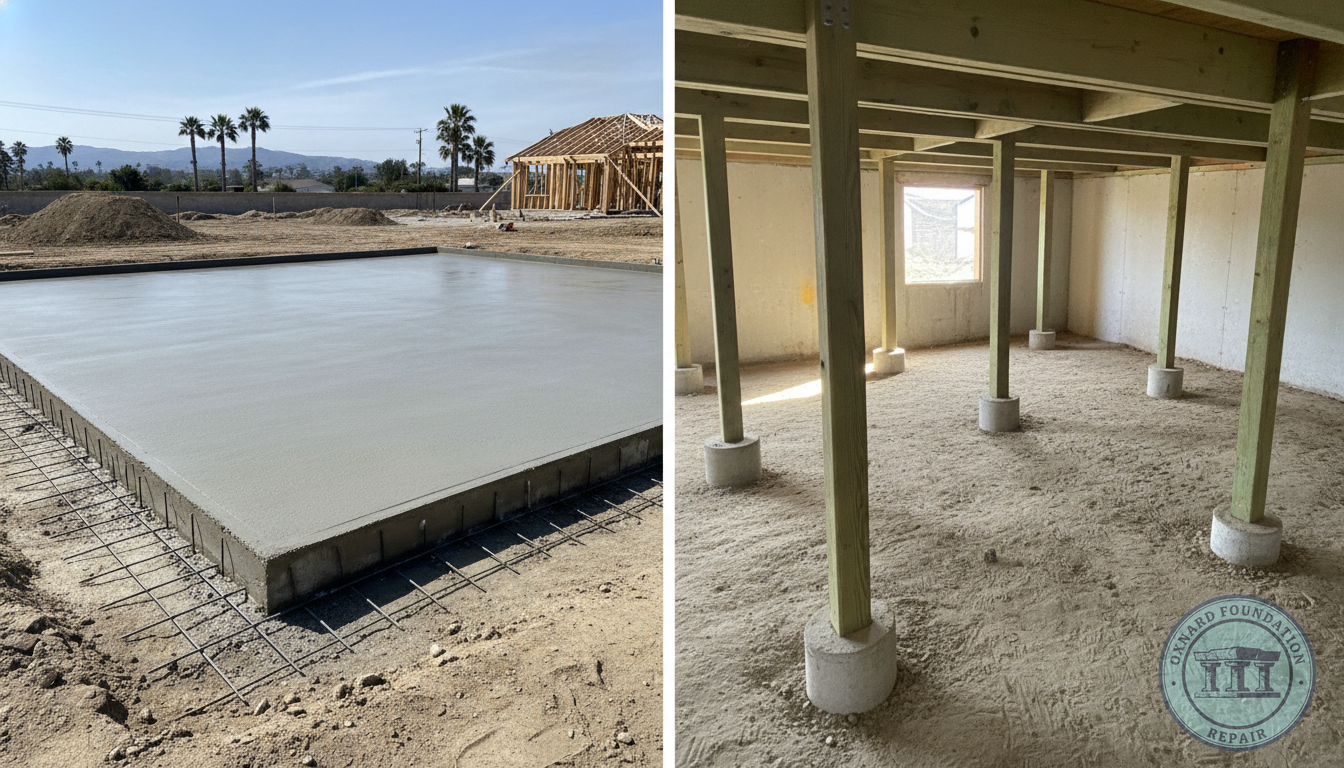
Two Foundation Types, One Demanding Climate
Drive through any Oxnard neighborhood and you'll find two distinct foundation styles doing the same job: keeping homes level, dry, and structurally sound. Slab-on-grade foundations dominate the post-1960s subdivisions that spread across the Oxnard Plain, while older craftsman bungalows and traditional homes near Heritage Square and along Saviers Road frequently sit on raised pier-and-beam systems. Both designs work well when properly maintained — but Oxnard's coastal climate, clay-heavy soils, and aging infrastructure create specific challenges for each type that every homeowner should understand.
At Oxnard Foundation Repair, we repair both foundation types throughout the city and across Ventura County. This guide breaks down how each system works, what makes it vulnerable in our local environment, and what the repair process looks like when something goes wrong.
How Slab Foundations Work — and Why They Settle
A concrete slab foundation is poured directly on compacted fill soil, with reinforcing steel (rebar or wire mesh) embedded in the concrete to resist cracking. Plumbing lines are run beneath or through the slab before it's poured, and the finished floor covering — tile, hardwood, carpet — is laid directly on top. This design is economical, fast to build, and provides a solid, low-maintenance base when the soil beneath stays stable.
The problem is that soil stability in Oxnard is never guaranteed. Here's what typically causes slab settlement:
- Soil drying and shrinkage: During dry summers, the clay soils common to the Oxnard Plain lose moisture and compress, removing support from the underside of the slab. The concrete cracks and drops into the void.
- Plumbing leaks: Water-supply or sewer lines running beneath slabs can leak for months before being detected. The escaping water erodes soil, washing it away from the slab's underside and leaving voids that cause sudden, localized settlement.
- Poor compaction: In rapidly developed Oxnard subdivisions from the 1970s and 1980s, fill soil was sometimes placed and compacted quickly. As the soil consolidates further under load over the years, the slab above settles unevenly.
Symptoms include uneven floors, cracks running across tile or hardwood, doors and windows that won't close properly, and gaps between walls and the ceiling or baseboards. Our slab foundation repair service addresses these issues using polyurethane foam injection to fill voids and lift the slab back to its original elevation — often in a single day with no need to tear out flooring.
How Pier-and-Beam Foundations Work — and What Goes Wrong
A pier-and-beam foundation elevates the floor system above grade level using a grid of concrete footings topped by wood posts or steel columns, which in turn support horizontal beams and floor joists. The crawl space created between the floor and ground provides easy access to plumbing, electrical wiring, and HVAC ducts — a genuine advantage over slabs. Older Oxnard homes on pier-and-beam systems were often built with rough-sawn redwood or Douglas fir framing that has held up admirably for decades.
But pier-and-beam foundations have a persistent enemy in Oxnard: moisture. The crawl space beneath a raised home naturally collects humidity evaporating from bare soil, and in Oxnard's coastal climate that ambient moisture level is already elevated year-round. When crawl spaces lack adequate vapor control, the consequences compound over time:
- Wood rot and decay: Continuously damp conditions promote fungal growth on posts, beams, and subfloor sheathing, softening structural lumber until it no longer carries its intended load.
- Termite activity: Subterranean termites thrive in damp, wood-rich crawl spaces. Damage can progress silently for years before sagging floors or cracked drywall bring it to light.
- Footing settlement: Concrete piers near the perimeter can sink or tilt when the soil beneath them becomes saturated and loses bearing capacity — particularly in neighborhoods near the Santa Clara River floodplain like El Rio.
Our pier-and-beam foundation repair service addresses all of these failure modes — replacing rotted posts with pressure-treated lumber or adjustable steel columns, installing new helical or push piers to underpin sunken footings, and shimming beams back to level using laser-guided hydraulic jacks.
Moisture: The Common Enemy of Both Foundation Types
Whether your home sits on a slab or a pier-and-beam system, moisture is the single most damaging long-term threat. For slab homes, water intrusion from poor site drainage erodes the soil beneath the concrete and promotes rebar corrosion. For pier-and-beam homes, crawl space humidity rots structural lumber and accelerates concrete footing deterioration.
The solutions differ slightly by foundation type but share the same principle: get water away from the structure before it can do damage.
- For slab homes, we recommend exterior foundation waterproofing and drainage correction to manage stormwater around the perimeter and prevent under-slab erosion.
- For pier-and-beam homes, crawl space encapsulation with a 20-mil vapor barrier, sealed vents, and a mechanical dehumidifier transforms a damp crawl space into a controlled, moisture-stable environment that protects structural lumber for decades.
Both services are particularly important for homeowners in Oxnard Shores, Hollywood Beach, and Channel Islands Beach, where ocean proximity keeps ambient humidity elevated and salt air can accelerate corrosion of exposed metal components.
Which Foundation Type Needs More Maintenance?
The honest answer is: it depends on the specific home, its age, and the site conditions. Pier-and-beam foundations generally require more active maintenance — periodic crawl space inspections, moisture monitoring, and occasional shimming or post replacement — but they also offer easier access for repairs when problems do arise. Slab foundations are lower-maintenance in stable soil but can be more disruptive and expensive to repair once significant settlement develops, because the solution often involves drilling through finished floors or excavating around the perimeter.
In Oxnard's challenging soil and climate environment, the best strategy for either foundation type is proactive inspection. Catching a settling void beneath a slab early — before it's three feet wide — or spotting soft spots in a crawl space post before the floor above starts to sag can save tens of thousands of dollars in repair costs.
Get a Professional Foundation Assessment in Oxnard
Oxnard Foundation Repair serves all of Oxnard and the surrounding communities, including Port Hueneme, Nyeland Acres, and El Rio. Whether your home has a slab or a pier-and-beam foundation, our team will conduct a thorough inspection, explain exactly what we find, and provide a written fixed-price estimate with no pressure to commit. Call us at (820) 777-4443 or email [email protected] — we're available seven days a week, 8:00 AM to 6:00 PM.
Confirm Availability
Call +18207774443 or fill out our online form for a free, no-obligation quote.
Request Free Quote