
What Are Helical Piers and How Do They Work?
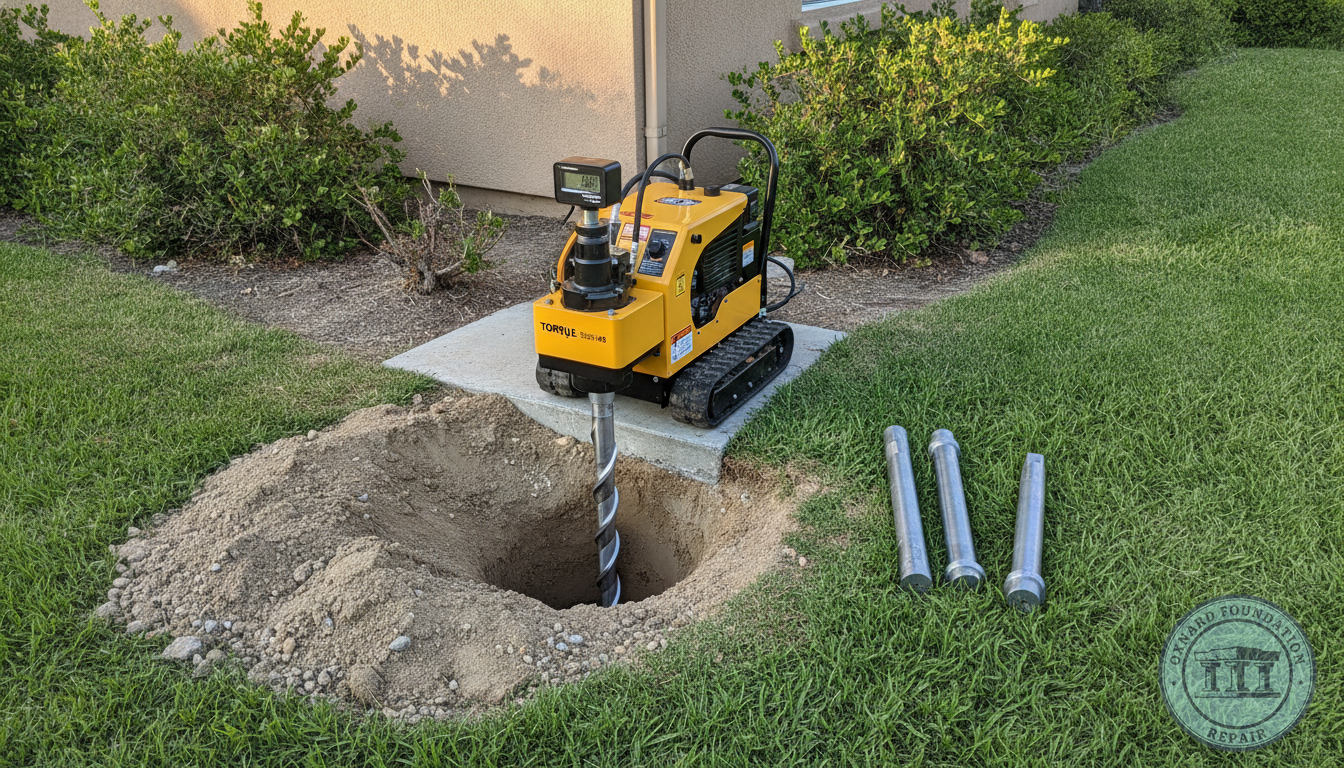
Helical piers are one of the most technically sophisticated — and most reliable — tools available for foundation repair. Picture a giant steel bolt: a round shaft of galvanized steel with one or more helix-shaped plates welded along its length, engineered to be rotated into the ground by a hydraulic torque drive motor until the helices engage stable, load-bearing soil far below the surface. Once each pier is installed to a target torque value that confirms adequate bearing capacity, a steel bracket is connected to the existing foundation footing and the structure is hydraulically lifted to its original elevation.
Unlike traditional concrete underpinning methods that require days of curing time before they can accept load, helical piers begin carrying foundation load immediately after installation. The entire process is remarkably clean: no concrete trucks, no large excavators tearing up your yard, and no interior demolition. Our helical pier installation service in Oxnard uses compact equipment that can work through tight side-yard gates and around existing landscaping with minimal disruption.
Why Oxnard Soil Conditions Make Helical Piers Especially Effective
Helical piers work best when near-surface soils are unstable — exactly the conditions that prevail throughout the Oxnard area. The Oxnard Plain is underlain by alternating layers of silty clay, loose alluvial sandy loam, and pockets of organic material deposited over centuries by the Santa Clara and Ventura rivers. These near-surface layers are prone to moisture-driven expansion and contraction, long-term consolidation under building loads, and rapid loss of bearing capacity when saturated.
By driving helical piers through these problematic layers and terminating them in denser, competent soil strata 15 to 30 feet below grade, we effectively bypass the zone of seasonal instability entirely. The foundation is then supported by soil that doesn't move with the seasons — delivering a genuinely permanent solution rather than a temporary fix.
This approach is particularly valuable in the communities we serve around Oxnard:
- El Rio sits near the Santa Clara River floodplain, where loose alluvial deposits can extend to considerable depth, making deep helical pier installation essential for reliable underpinning.
- Nyeland Acres features clay-dominant soils that shift seasonally and are a leading cause of gradual differential foundation settlement in this unincorporated Ventura County community.
- Channel Islands Beach and Hollywood Beach sit on sandy, moisture-rich coastal soils that offer minimal bearing capacity near the surface, making deep pier support critical for any structural underpinning project.
Signs Your Oxnard Home May Need Helical Pier Underpinning
Foundation settlement rarely announces itself dramatically. More often, it's a gradual accumulation of small, easy-to-dismiss signals that compound over months or years. Watch for:
- Floors that slope noticeably toward one corner or side of the home
- Doors and windows that suddenly stick, drag, or no longer latch properly
- Diagonal cracks in drywall, especially at the corners of door and window openings
- Gaps appearing between interior trim and the ceiling or floor
- Visible separation between an exterior porch or stoop and the main foundation
- Foundation cracks that keep returning despite previous repairs
If you've previously had foundation cracks repaired and they are reappearing, that's a strong indicator that the underlying settlement has not been arrested. Sealing a crack without stopping the movement that caused it is like painting over rust — the problem will keep coming back until the root cause is addressed.
The Helical Pier Installation Process: Step by Step
Understanding what to expect makes the repair process far less stressful. Here's how our Oxnard team approaches a typical helical pier project:
- Step 1 — Foundation Inspection and Pier Layout Planning: We begin with a thorough structural assessment, measuring floor elevations throughout the home and mapping the extent and direction of settlement. From this data we determine the number of piers required, their spacing, and the target depth and torque specification for each location. You receive a written pier layout plan before any work begins.
- Step 2 — Excavation of Pier Pits: Small pits approximately 24 inches wide and 36 inches deep are hand-dug or excavated with a compact machine at each pier location along the foundation perimeter. The exposed footing is cleaned and prepared for bracket installation.
- Step 3 — Pier Installation: Starting with a lead section fitted with the helix plates, each pier is driven into the ground by a hydraulic torque motor mounted on a compact track machine. Extension shafts are added as the pier descends. Installation continues until the monitored torque value confirms that the pier tip has engaged load-bearing soil at the required depth — typically 15 to 30 feet in Oxnard's variable soil profile.
- Step 4 — Bracket Attachment and Lifting: Once all piers are installed, a galvanized steel bracket is bolted to the existing foundation footing at each pier location. Hydraulic jacks are positioned on the brackets and synchronized to lift the foundation uniformly. This process can often recover a significant portion of the original settlement, returning floor elevations to near-original levels.
- Step 5 — Backfill and Site Restoration: Pier pits are backfilled with compacted soil, disturbed landscaping is restored, and any concrete flatwork that was removed to access the footing is patched. We also seal active foundation cracks that resulted from the settlement as part of a complete repair.
How Helical Piers Complement Other Foundation Repair Services
Helical pier installation rarely stands alone as the complete solution. Settlement typically damages the visible parts of the foundation and floor system as it progresses, so a comprehensive repair often involves coordinating multiple services:
- After lifting a settled slab, we pair helical piers with slab foundation repair — filling voids beneath the concrete with foam injection and sealing surface cracks — to deliver a complete, stabilized result.
- For raised homes, helical underpinning of settling footings is often paired with pier-and-beam foundation repair — replacing damaged wood posts, shimming beams to level, and installing new structural hardware above the underpinned footings.
- Because the excavation and lifting process can disturb perimeter drainage, we frequently recommend foundation waterproofing as a simultaneous upgrade to prevent future water-driven settlement from starting the cycle again.
- For homes in Port Hueneme and other coastal communities with raised foundations, combining helical pier underpinning with crawl space encapsulation protects the structural timber above the newly stabilized footings from the moisture that likely contributed to the original settlement.
Frequently Asked Questions About Helical Piers in Oxnard
How long does the installation take? A typical residential project with six to twelve piers is completed in one to three days. Larger commercial projects or homes with significant settlement requiring careful controlled lifting may take longer, but we provide a firm timeline in your written proposal.
Will my landscaping be damaged? Excavation pits are small — typically 24 by 36 inches — and we work carefully around existing plantings. Mature trees are virtually never affected because pier locations are chosen to avoid root zones wherever possible. Shrubs adjacent to the foundation may need temporary relocation but are replanted after backfill.
Is there a warranty? Yes. Oxnard Foundation Repair provides a written warranty on all helical pier installations covering both materials and workmanship. Pier systems from our suppliers also carry manufacturer transferable warranties, which can be a selling point if you decide to sell your home in the future.
Do helical piers work for commercial buildings? Absolutely. Helical piers are engineered for applications ranging from single-family homes to multi-story commercial structures. The shaft diameter, helix plate configuration, and installation torque are scaled to the structural load being supported.
Get Your Free Foundation Evaluation in Oxnard
If your home is showing any of the settlement warning signs described above, don't wait for the damage to worsen. Oxnard Foundation Repair serves homeowners and businesses throughout Oxnard and Ventura County — from Nyeland Acres and El Rio to Oxnard Shores and Port Hueneme. We'll send a trained inspector to evaluate your foundation, document our findings with photos and elevation measurements, and provide a written fixed-price estimate at no charge. Call us at (820) 777-4443, email [email protected], or visit us at 650 Hobson Way, Suite 103, Oxnard, CA 93030. We're open Monday through Sunday, 8:00 AM to 6:00 PM.
Confirm Availability
Call +18207774443 or fill out our online form for a free, no-obligation quote.
Request Free Quote